
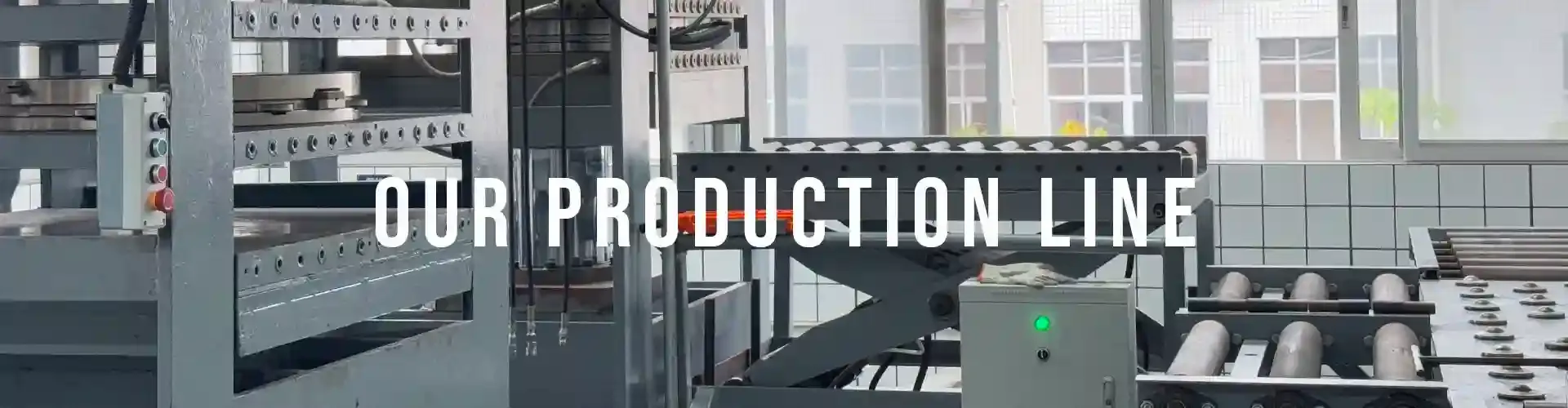
Our Production Line
How does raw carbon fibre become a wheelset you can race on? Inside our own factory, five core processes turn prepreg sheets into finished wheels: carbon preparation and layup, molding and curing, precision drilling, cross-sectional inspection, and finishing and painting. Because every stage happens under one roof, we control — and document — quality at each step rather than outsourcing it. Walk through each process below with photos from the actual production floor, and see why in-house manufacturing is the foundation of every wheel we stand behind.

Carbon Preparation and Layup for Rim Manufacturing
Every rim begins with carbon fiber sheets cut to engineered patterns. Technicians place each layer by hand according to the rim’s layup schedule. Fiber direction and ply placement affect the rim’s strength, stiffness, and weight, so careful layup helps put material where it is needed without adding unnecessary bulk. This step creates the structural foundation of the rim before it ever enters the mold.
Carbon Rim Molding and Curing Process
After layup, the carbon structure is placed into a custom-machined mold. The rim is cured under controlled temperature and pressure so the resin can set properly and the rim can take its final shape. Consistent molding helps reduce weak spots, shape variation, and hidden defects that could affect the finished wheel. The result is a rim structure designed to build predictably and perform consistently from one wheel to the next.
Spoke Hole and Drainage Hole Drilling for Carbon Rims
This new generation of precision drilling machines is specifically designed for high-end wheel manufacturing, with drilling diameters ranging from 1.5 to 11 mm. The spindle angle can be adjusted bidirectionally within a range of -11° to +11°, enabling the effortless machining of vertical holes, angled holes, and chamfering of spoke holes. It also supports the drilling of drainage holes and the clamping of the full range of 20–32-inch wheels. With a repeat positioning accuracy of up to ±0.05 mm, it significantly improves wheel roundness and spoke lacing efficiency, replacing multiple processes with a single machine.
Cross-Sectional Inspection of Carbon Rim Cut Pieces
Technical Description The rim cutting test (sectional inspection of cut pieces) involves analyzing the cross-sections of the rim by cutting a portion to evaluate internal and external features. This inspection focuses on identifying any burrs, irregularities, or deviations in dimensional specifications to ensure the rim meets our stringent quality standards.
Carbon Rim Finishing and Painting
Each Light Travel rim is finished by experienced technicians. The rim is sanded, primed, painted, and labeled to create a smooth final surface and completed custom appearance. This process gives each wheel its final look while also helping technicians check surface quality before the rim leaves the factory. The result is a beautiful wheel, built custom for you.
Production Common Questions
In our own factory. Carbon preparation, layup, molding and curing, drilling, and finishing all happen under one roof, which lets us control quality at every step instead of outsourcing critical stages. The five core processes are documented on this page with photos from the actual production floor.
Pre-impregnated carbon fibre sheets (prepreg) are cut to ply patterns, then hand-laid into the rim mould layer by layer. The orientation, overlap and sequence of each ply are specified per rim model — this layup schedule is where stiffness, strength and weight targets are actually engineered. Bladder-assisted layup removes trapped air before the mould closes.
Moulds are cured in temperature- and pressure-controlled ovens on validated time/temperature curves, with internal bladder pressure held throughout to consolidate the laminate and keep walls uniform. Cycle parameters are logged per batch, and cured rims are weighed and dimensionally checked before they proceed — an under-cured or over-heated part is rejected at this gate.
Spoke holes are stress concentrators: an off-axis or rough-edged hole becomes the starting point for fatigue cracks. We drill with dedicated fixtures per rim model, then deburr and reinforce each hole so spoke tension loads the laminate evenly. Drainage holes are placed to let water escape the rim cavity, keeping wheelsets balanced in wet conditions.
Every rim is surface-inspected, sanded and masked before paint and decals, then clear-coated and cured again. Finished wheels go through a final 100% inspection — true, spoke tension, air-leak and visual — before packing. Cross-sectional inspection of cut samples from each batch verifies wall thickness and consolidation, closing the loop between process and product.
